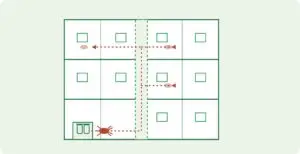
A mixed-use building is really several buildings stacked into one: homes above, shops or offices below, sometimes a gym or restaurant in the mix, all sharing a structure, services and an address.
It’s one of the most demanding things to manage well, because the people using the building want very different things at very different times. After thirty years managing Sydney buildings, including mixed-use ones, I can tell you the difference between a smooth mixed-use building and a fractious one is almost always the quality of the management holding it together. Here’s what makes it hard, and how it’s done well.
What “Mixed-Use” Actually Means
A mixed-use building combines residential lots with commercial ones — typically apartments above ground-floor retail, cafes, offices or other businesses. The uses share the same physical structure and often the same core services — fire systems, lifts, plant, entries, waste — while operating on completely different rhythms and with different priorities. That combination of shared infrastructure and divergent needs is the heart of the challenge.
Why It’s Harder Than a Purely Residential Building
Several tensions run through almost every mixed-use building:
- Different rhythms. Residents want quiet evenings and weekends; a ground-floor cafe or bar is busiest exactly then. Deliveries, waste collection and servicing for the commercial tenancies can clash with residential amenity.
- Competing priorities. Retail wants visibility, signage, foot traffic and access; residents want security, privacy and peace. Both are legitimate, and both use the same building.
- Shared versus separate. Some infrastructure is genuinely shared; some serves only one use. Working out who is responsible for what, and who pays for what, is more complex than in a single-use building.
- Security zoning. The commercial areas may need public access during trading hours while the residential areas must stay secure at all times — which requires careful zoning of access and entries.
The Building Management Statement
Many mixed-use developments are governed by a building management statement — a registered document that sets out how the shared parts of the building are managed, maintained and paid for across the different components (for example, a residential strata scheme and a commercial component). It typically establishes how costs for shared services are apportioned and how the parts coordinate. Understanding and working within that framework is fundamental to managing a mixed-use building properly, and it’s where a lot of avoidable disputes begin when it’s ignored.
Cost Allocation: The Perennial Friction Point
The single most common source of tension in mixed-use buildings is who pays for what. If the commercial tenancies generate more waste, use more water, or drive more wear on a shared entrance, should they carry more of those costs? Fair, transparent apportionment — usually framed by the building management statement — is essential, and getting it wrong breeds resentment between the residential and commercial sides that can poison everything else. Clear metering, clear records and clear logic behind the split are what keep it civil.
Coordinating the Uses Day to Day
Beyond the framework, mixed-use management is a daily coordination job: sequencing deliveries and waste collection so commercial servicing doesn’t wake residents; managing shared loading docks and car parks used by both; keeping the commercial and residential access properly zoned and secure; handling the noise, hours and amenity issues that inevitably arise between businesses and homes; and being the neutral point that both sides can bring problems to. Done well, the two uses barely notice each other. Done poorly, they’re in constant low-grade conflict.
Where a Building Manager Fits In
Mixed-use is where an experienced, genuinely independent building manager earns their keep, because so much of the job is holding competing interests in balance. We coordinate the shared services and their servicing rhythms, manage security zoning between public commercial areas and secure residential ones, keep the day-to-day operation running across both uses, and act as the neutral, practical point of contact that stops small clashes escalating. The formal cost-apportionment and governance sit within the building management statement and with the relevant owners corporations and their strata managers; the building manager makes the shared building actually work, every day, for everyone in it. Independence matters even more here — with residential and commercial interests to balance, a building manager whose only loyalty is to the building as a whole is exactly what you want.
Frequently Asked Questions
What makes mixed-use buildings harder to manage?
Different users wanting different things from the same building at the same time — residents wanting quiet and security, commercial tenancies wanting access, visibility and out-of-hours servicing — all sharing core infrastructure. The combination of shared services and divergent needs makes coordination, cost allocation and security zoning far more complex than in a purely residential building.
What is a building management statement?
It’s a registered document that governs how the shared parts of a mixed-use building are managed, maintained and paid for across its different components. It typically sets out how shared-service costs are apportioned and how the residential and commercial parts coordinate. It’s the framework a mixed-use building runs on.
How are costs split between residential and commercial in a mixed-use building?
Usually according to the building management statement, which frames how shared costs are apportioned between the components. Fair, transparent allocation — ideally supported by metering and clear records — is essential, because cost-sharing disputes are the most common source of friction between the residential and commercial sides.
Does a mixed-use building need a specialist building manager?
It benefits from an experienced one. Mixed-use management demands coordinating shared services, zoning security between public and private areas, and balancing competing interests — skills that go beyond single-use residential management. An independent building manager, loyal to the building as a whole rather than one side of it, is particularly valuable here.
Managing a Mixed-Use Building?
Building Management Australia is a Sydney building management firm — not a strata agent — with experience managing residential, commercial and mixed-use properties. We coordinate shared services, manage security zoning, and hold the balance between residential and commercial interests so a mixed-use building runs smoothly for everyone in it, working alongside the relevant strata managers.
If you’re responsible for a mixed-use building, request a proposal at bmaus.com.au or email Andrew directly at andrew@bmaus.com.au.
About the Author
Andrew Veron is the founder of Building Management Australia (BMA), an independent Sydney building management firm established in 1995. BMA is a building management company — not a strata agent — providing on-site and visiting building management, facilities management, concierge, cleaning and valet services to residential, commercial and mixed-use properties. Over the past 30 years, Andrew and the BMA team have managed buildings across the Eastern Suburbs, North Sydney, Inner Sydney, Parramatta and the Sydney CBD, with assets currently valued in excess of $3 billion under management. Because BMA is independent of any strata management firm, committees receive unbiased advice and transparent contractor relationships. Reach Andrew at andrew@bmaus.com.au or bmaus.com.au.
This article is general information only and is not legal advice. Building management statements and cost apportionment are governed by legislation and each building’s registered documents; owners corporations and building owners should obtain advice specific to their circumstances.