If your strata building has a shared pool or spa, it comes with a set of legal duties that sit squarely with the owners corporation — and they’re duties built around a sobering fact: drowning is a leading cause of preventable death in young children.
After thirty years managing Sydney buildings, I can tell you pool compliance is one of those obligations that’s easy to assume is handled and costly to get wrong. Here’s what your building actually has to do.
Who’s Responsible
Where a pool or spa sits on common property, all the lot owners jointly own it, and the owners corporation is responsible for ensuring it complies with the Swimming Pools Act 1992. A pool or spa, for these purposes, is broadly any structure capable of holding water more than 30 centimetres deep for swimming, wading or similar — which captures most shared pools and spa pools in apartment buildings.
Registration
Every pool and spa must be registered on the NSW Swimming Pool Register. Registration is straightforward — it can be done online or through the local council — and the owners corporation receives a certificate of registration. Worth being clear on one point: registration is not the same as compliance. A pool can be registered and still fail an inspection. Registration records the pool’s existence; compliance is assessed separately.
The Three-Yearly Inspection
This is the obligation specific to strata. Strata schemes with more than two lots must have any pool or spa inspected by the local council every three years, to confirm the barrier and safety measures still comply. The owners corporation arranges this through the council, and a certificate of compliance, once issued, is valid for three years — which lines up neatly with the inspection cycle. Keeping track of when that inspection falls due is exactly the kind of deadline that slips without someone watching it.
Fencing and Barrier Requirements
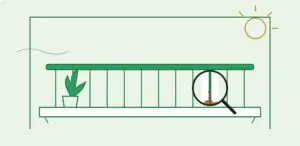
The barrier is the heart of pool safety, and the requirements are specific. In broad terms, a compliant barrier must:
- Be at least 1.2 metres high, measured from the finished ground level.
- Have no gap larger than 10 centimetres at the bottom of the fence or between vertical rails.
- Maintain a non-climbable zone — generally around 900 millimetres clear of anything a child could use to climb.
- Have gates that are self-closing and self-latching, open away from the pool, and latch out of a child’s reach.
A surprising number of barriers fail inspection for small, fixable things — a gate that doesn’t self-latch, a pot plant or piece of furniture creating a foothold, or a worn hinge. These are easy to prevent with regular attention and easy to miss without it.
CPR Signage
Every pool must display a compliant, current CPR sign, prominently positioned and legible from a few metres away. It’s a small requirement that’s frequently overlooked — signs fade, get removed, or fall out of date — and it’s a common reason a pool fails an otherwise straightforward inspection.
A Note on Selling and Leasing
For standalone homes, a certificate of compliance generally has to be provided when selling or leasing. Helpfully, that particular requirement doesn’t apply to lots in a strata scheme with more than two lots — those schemes are covered instead by the three-yearly council inspection regime. It’s a sensible carve-out, but it doesn’t reduce the owners corporation’s underlying duty to keep the pool compliant.
Where a Building Manager Fits In
Pool compliance is a mix of scheduled obligations and constant small maintenance — precisely what a building manager handles. We track the registration and the three-yearly inspection deadline, keep the barrier and gates maintained between inspections, make sure CPR signage is current, coordinate the council inspection and any rectification works, and watch for the everyday hazards — the propped gate, the climbable object, the faulty latch — that cause both failures and, far worse, accidents. The owners corporation holds the legal duty; the building manager makes sure it’s met, working alongside the strata manager.
Frequently Asked Questions
Does our strata pool need to be inspected every year?
Not every year — strata schemes with more than two lots must have their pool or spa inspected by the council every three years, and a certificate of compliance lasts three years. That said, the barrier needs maintaining continuously between inspections, because a gate or fence can fall out of compliance at any time.
Is registering our pool enough?
No. Registration records that the pool exists; it doesn’t confirm the barrier is safe. Compliance is assessed separately through inspection, and a registered pool can still fail. Both registration and ongoing compliance are required.
Who pays for pool compliance in a strata building?
The owners corporation, as the collective owner of a common-property pool. Costs — inspections, signage, barrier repairs and any rectification — are met by the scheme, typically through the administrative fund, with larger works potentially planned through the capital works fund.
What are the most common reasons pools fail inspection?
Small, avoidable things: gates that don’t self-close or self-latch, climbable objects too close to the fence, gaps in the barrier, worn hardware, and missing or faded CPR signage. Most are cheap to fix and easy to prevent with regular maintenance — which is the case for keeping someone on top of it year-round.
Need Your Pool Compliance Kept on Track?
Building Management Australia is a Sydney building management firm — not a strata agent. Tracking pool registration and the three-yearly inspection, maintaining barriers and signage, and coordinating council inspections and rectification is core building-management work, and we handle it alongside your strata manager.
If your building has a pool or spa and you’re not certain it’s on track, request a proposal at bmaus.com.au or email Andrew directly at andrew@bmaus.com.au.
About the Author
Andrew Veron is the founder of Building Management Australia (BMA), an independent Sydney building management firm established in 1995. BMA is a building management company — not a strata agent — providing on-site and visiting building management, facilities management, concierge, cleaning and valet services to residential, commercial and mixed-use properties. Over the past 30 years, Andrew and the BMA team have managed buildings across the Eastern Suburbs, North Sydney, Inner Sydney, Parramatta and the Sydney CBD, with assets currently valued in excess of $3 billion under management. Because BMA is independent of any strata management firm, committees receive unbiased advice and transparent contractor relationships. Reach Andrew at andrew@bmaus.com.au or bmaus.com.au.
This article is general information only and is not legal advice. Pool and spa requirements are set by legislation and local councils and can change; owners corporations should confirm current obligations with their local council, an accredited certifier or NSW Fair Trading.